Hardcover edition
A printed book for your workshop or reference shelf. View the Shopify listing for the current price and delivery details.
Buy hardcoverSpecialist damping textbook · Craig Dixon
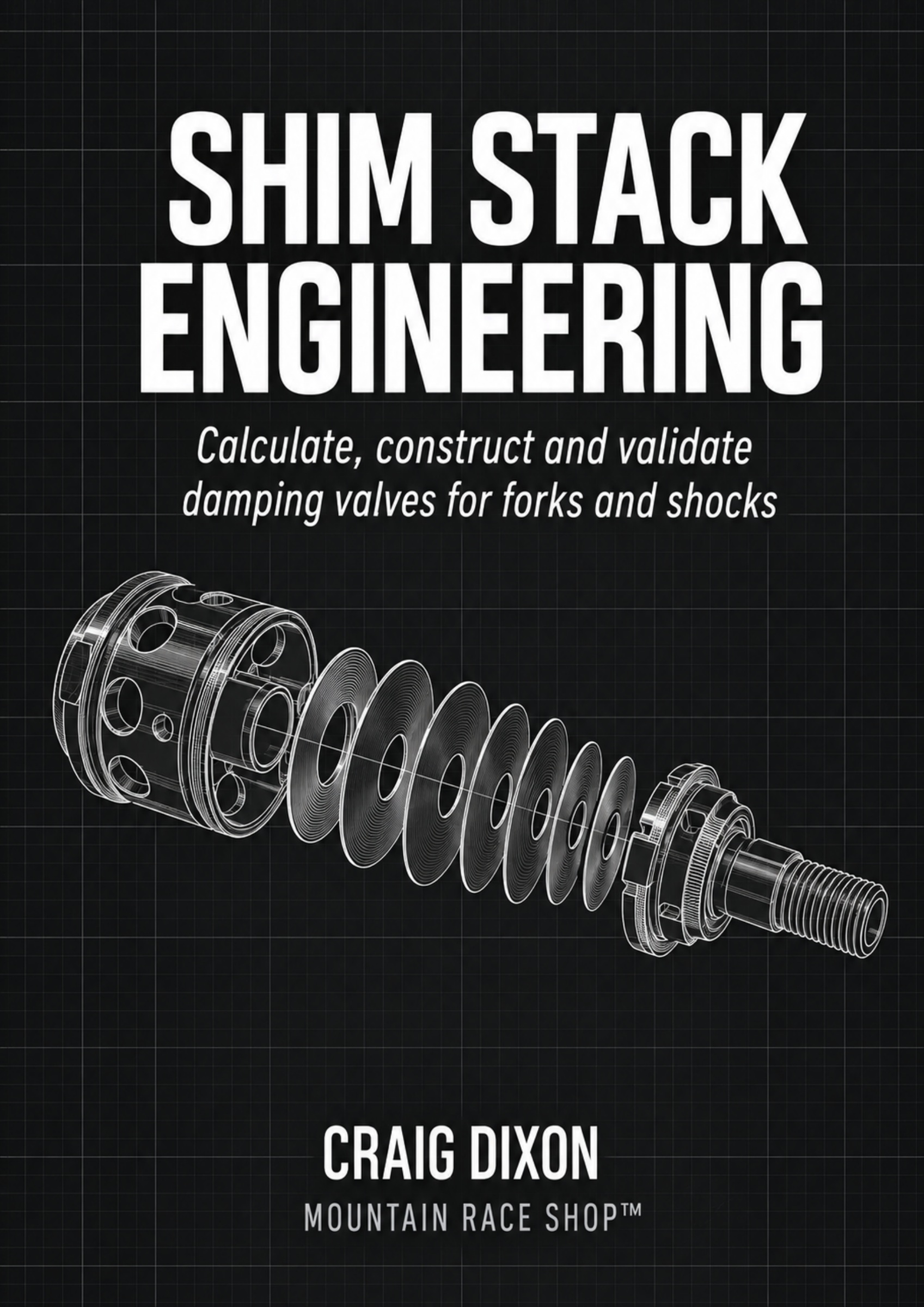
Calculate, construct and validate damping valves for forks and shocks.
Understand what each shim does—and calculate what happens when you change it.
Choose your format on Shopify (hardcover) or Payhip (PDF).
Inside the book
Also includes references, design and validation records, a guide to reading the mathematics, a plain-language glossary, and worked-example, equation and subject indexes.
Read before you buy
A reading sample from Chapter 1, Section 1.2 and Worked example 1A. Equations are reformatted for this web page; their book numbers are retained.
Picture a sealed piston in a straight cylinder. A rod of the same diameter leaves both ends of the piston. We call this a double-rod test fixture. Both pressure sides therefore have the same active area. Oil pushed out of one side passes through a valve and enters the other.
There is no gas reservoir in this example and no net oil displacement caused by the rod entering the cylinder. The rod volume entering one end equals the rod volume leaving the other end. The piston still moves oil between its two chambers. It is a useful teaching fixture; it is not a generic model of every shock or fork.
Convert millimetres to metres by dividing by 1,000.
Square each diameter, subtract the rod result from the bore result, then multiply by pi and divide by four.
Multiply active area by shaft velocity to find the oil flow.
For a 36 mm bore, a 12 mm through-rod and a shaft velocity of 0.300 m/s:
What this tells us: the valve must pass that volume at this shaft speed. We have not chosen pressure or shim thickness yet. Those require the valve's resistance to flow.
The complete chapter continues through pressure, shim opening and a complete operating point. The teaching examples require measurement and physical testing before a real design can be validated.
Written by Craig Dixon of Mountain Race Shop™, this specialist textbook takes you from the basics of oil flow and pressure through to designing shim stacks and checking their performance on a suspension dyno.
The book combines advanced engineering with plain-language explanations, defined symbols, numbered equations and worked examples. It starts with the foundations, then builds towards the calculations needed to make informed decisions about fork and shock damping.
Includes numbered equations, step-by-step worked examples, diagrams, a guide to reading the mathematics, a glossary, equation and subject indexes, and Harvard-style references.
Suitable for suspension technicians, race mechanics, engineering students and riders who want a deeper understanding of damping design. No previous shim-stack design experience is assumed; the later chapters build on the earlier explanations.
Calculations provide a starting point for design. Measurement, careful assembly and dyno testing remain part of confirming how a particular valve performs.
A printed book for your workshop or reference shelf. View the Shopify listing for the current price and delivery details.
Buy hardcoverA complete textbook to read on screen or print for personal workshop reference. This listing is for the digital edition; no physical book is supplied.
Buy PDF downloadLooking for the broader suspension reference? Explore The Suspension Engineer’s Handbook or browse all books.